



Suche:
- # Artistry
- # Biology
- # Chemistry
- # Ecological
- # Economy
- # English
- # Foreign Language
- # Geography
- # German
- # Health
- # History
- # Informatik
- # Latin
- # Mathematics
- # Media Education
- # Music
- # Physics
- # Politics / Civics
- # Preschool
- # Primary School
- # Religion
- # Society
- # Sports
- # Technology
- # Training of Teachers
- # Vocational Education
Human Brain
Every organism, no matter whether it is an earthworm, a snail, a fish or a human being, takes in information from the environment through differently structured sensory organs. This was absorbed first by a diffusely organised nervous system, which, in the course of evolution, has been replaced by a hierarchically organised one. Eventually a controlling centre has developed that interconnects and coordinates the nerve impulses supplied by receptors, reacts appropriately and is called the brain. In more highly developed organisms a part of the body has developed into a head, in parallel to the development of the brain.
Learn moreHuman Lung
Only rarely do we notice that we need them: our lungs. Mostly, we breathe unconsciously and shallowly – especially if we have a sitting job.
Learn moreHorses
They are the epitome of power and elegance. Man domesticated them long after dog and cat, they provided meat, were strong agricultural helpers pulling ploughs and other implements. These hard times are over for the animals – their range of service has changed. The most favourite animal of many children and grown-ups, it has changed from former working animal to today’s companion for sport and leisure. The horse breeds known today are descended from a primeval horse. It lived about 50 million years ago – that is fifty with six zeros after it!
Learn moreReptiles
This DVD offers a clearly structured overview over reptiles with an emphasis on the following aspects: The origin of reptiles is proven by fossil finds from all over the world. The skeletons are proof that reptiles were not confined to life on land but were also adapted to water and the air. The typical common characteristics of reptiles, such as the coat of scales and a poikilothermic body temperature, as well as the extremely different appearances of poisonous snakes and constrictors, turtles, lizards and crocodiles are discussed in detail. The different methods of finding food both as a herbivore or as an ambush predator with the use of poison or with the help of a pit organ are shown. The “invention” of the amnion made the reptiles’ reproduction independent from water and enab- led them to lay their eggs on land.
Learn moreTicks
Already the dinosaurs, which populated the Earth some 90 million years ago, were familiar with the tiny, dangerous pests, and the Greek poet Homer attributed healing and potency-enhancing effects to them in the late 8th century BC – however, only in pulverised form. The animals described are those clingy, blood-sucking mini-vampires – the ticks. In fact, they are parasites dangerous to us humans; not because of the amount of blood they extract but due to the diseases they can transmit in doing so. This film invites you to visit the family of the small parasites of the phylum Athropoda belonging to the class of Arachnida.
Learn moreBasics of BIOLOGY I
Basics of Biology examines general biological issues that help to expand and consolidate basic biological knowledge. The first film of this series deals with the structure of the plant cell. It centres around the structure and function of plant tissue such as the xylem, root cells and stomata as well as the functions of the chloroplasts. In the second chapter the issue of photosynthesis and the elements involved in it are dealt with. With tests and experiments impacts of light and CO2 on photosynthesis are demonstrated and explained. The third part explains human respiration. The rising oxygen consumption of a woman athlete brought on by physical effort on the moving walkway is shown. What happens when the physical stress becomes too strong and the amount of oxygen inhaled is no longer sufficient? The transition from aerobic respiration to anaerobic respiration is vividly illustrated. Together with the extensive accompanying material the didactic DVD is ideally suited for use in the classroom.
Learn moreNew Species in our Environment
More and more animal and plant species successfully spread far away from their original homes. They are organisms that with our assistance – or even alone – are disseminated further and further across the globe: they are called invasive species.
Learn moreIndian Priests
Is there anything unusual about Father Xavier, a coloured missionary from India, working as a priest in Germany? The film begins with Xavier in his Indian home village where people Christianity is part of people’s everyday lives. Then we see him work as a chaplain in a community in Munich where he is faced with the situation of the Church in Germany: empty rows and mainly senior churchgoers. He learns that foreigners are not always welcomed with open arms. What does “mission” mean today? Has Germany become a place in need of missionary work? If there is a shortage of young priests in Germany, is it possible to simply invite young priests from other cultures, from the churches of Asia, Africa and Latin America to come here? Are they bringing the message they once received from missionaries back to Europe? Does evangelisation now take place the other way round?
Learn moreGeologic Activities
The formation of our earth began according to today's knowledge from a huge cloud of dust and gases about 4.6 billion years ago.
Learn moreRome
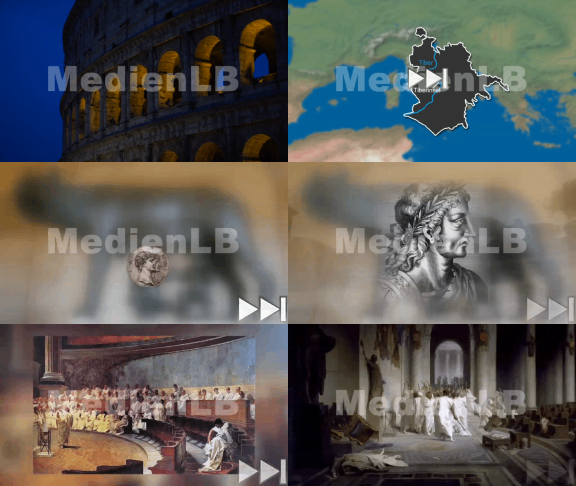
On the Tiber, in the centre of Italy, there lies the Italian capital of Rome. The “Eternal City” as it was called by the poet Tibullus more than 2,000 years ago, is located on a plain between the foothills of the Apennine and the Tyrrhenian Sea.
Learn moreCapitals of Central Europe II
This DVD presents the capitals of eastern Central Europe, Bratislava, Budapest, Prague and Warsaw. By way of intro- duction, the pupils learn about the natural and climatic bound- aries of the Central European region and which countries it encompasses. Based on this, the film first focuses on the topographic situation of the respective capital of the countries of Slovakia, Hungary, the Czech Republic and Poland and the development of the cities is briefly outlined. Imposing buildings, historical monuments, architectural characteristics, magnificent operas and theatres, but also multi-cultural life in the streets and living traditions are witnesses to the rich cul- ture and artistic atmosphere of these capitals in the heart of Europe. Impressive pictures capture the uniqueness of each one of the capitals and illustrate their characters. Here, the respective geographic location of the capitals is linked to the history of their foundation. The pupils can follow the respective city development, learn about important sights, may compare the economic power and the infrastructures of the cities and will, step by step, obtain a complete picture of the diversity of the unified Europe.
Learn more